The Beginning: A Vision Takes Shape
Part one of our “Foundations: Building Carolina Horse Park” series. Denny Emerson shares the story behind Carolina Horse Park.
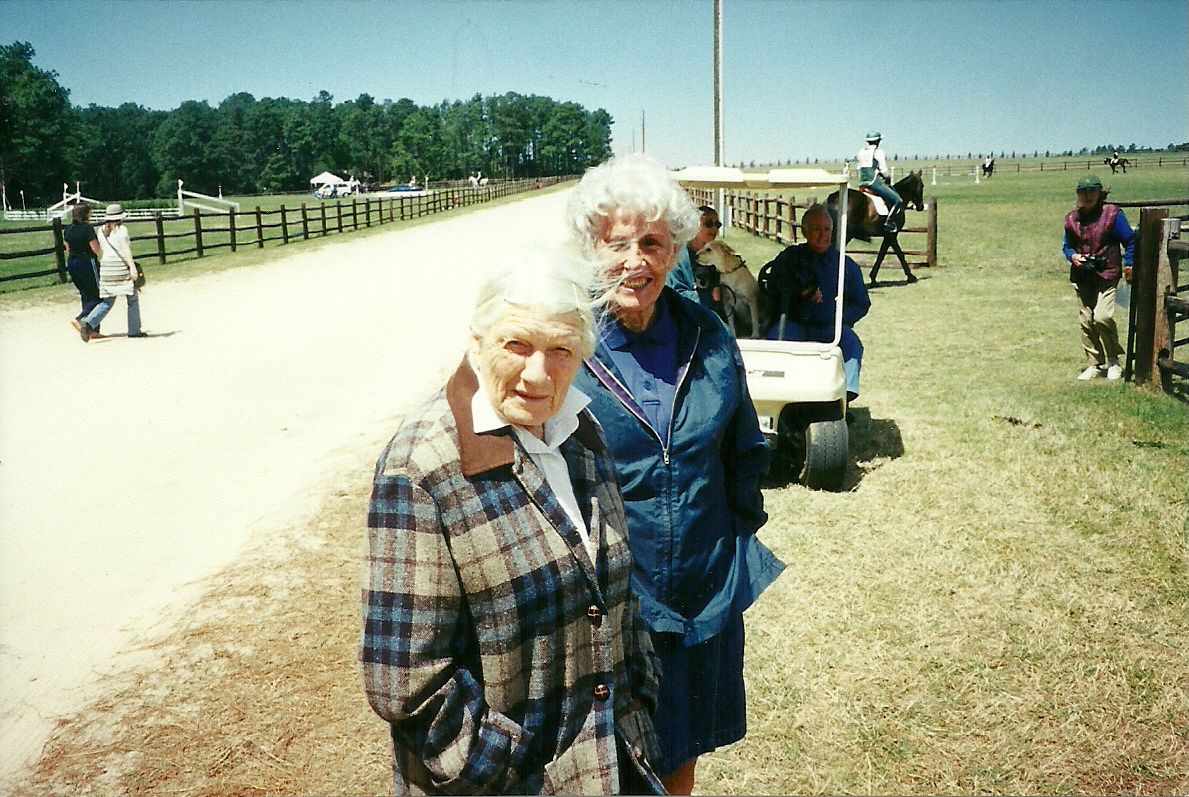
Pictured: Virginia (Ginny) Moss, an early supporter of Carolina Horse Park, with Joanie Hopewell watching the former Longleaf Pines Horse Trials which later moved to the Carolina Horse Park and is still hosted here today.
I don’t think that in the late 1990s, when we created a nonprofit organization to purchase the original 180 acres, it was on many people’s radar that this modest tract of land would one day grow into a multi-use equestrian center, complete with full-time staff, permanent buildings, and a sprawling infrastructure.
Others might remember more—please chime in—but at the time, our thinking was fairly simple. We saw the land mainly as a fallback location to host horse trials, assuming that eventually we might lose access to the Walthour-Moss property.
Then someone noticed the huge open meadow beside Horace Walters Road and said, “Hey! What about reviving the Stoneybrook race meeting?”
That idea caught people’s imagination right away.
Before anything else could happen, though, we realized the first step was going to be a major cleanup.
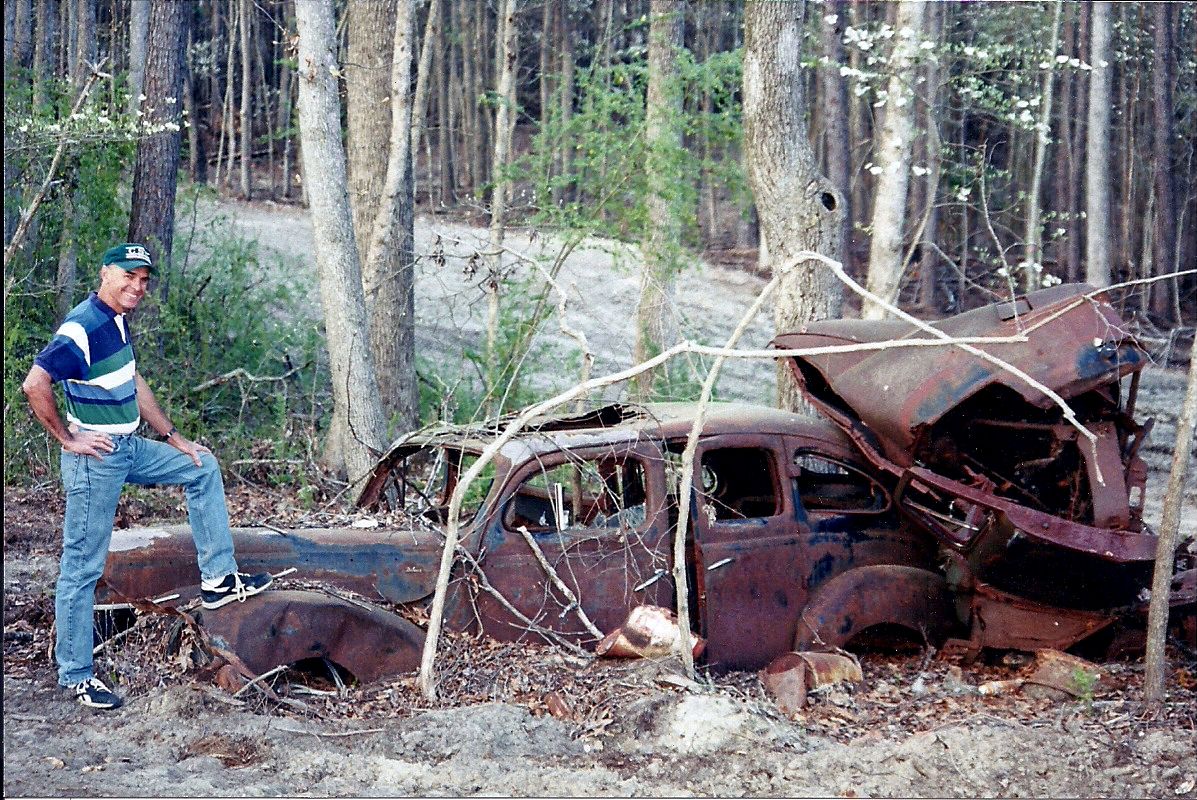
Over many years, the land had been used as a dumping ground. Beer bottles and other trash were scattered everywhere. Junk cars sat rusting away in the woods, and an unsightly power line ran straight down the middle of the open land.
We organized cleanup days and called on volunteers to help. We handed out the same big plastic bags you see used along highways, and slowly—but surely—the property became less of a glass-bottle minefield. It was not glamorous work, but it was necessary, and people showed up.
Somewhere along the way—probably through the efforts of Roger Secrist, who, because of his strong business background, became the unofficial chairman of the board—the power company was convinced to move the line. That alone was a major victory.
At the same time, the land itself needed attention. Fields were mowed, plowed, and reseeded. If memory serves, much of that heavy lifting was done by Rod Lynch, whose work helped transform rough ground into usable space.
The early cross-country lanes began to take shape as well. I can’t recall exactly who designed those first routes, but trails had to be opened, brush cleared, and years of neglect undone. It was a slow process, but each improvement made the vision feel a little more real.
Another major step came with the purchase of additional land on the opposite side of Montrose Road—the area where the stabling stands today. There was a house on the property in poor condition, which was eventually repaired and became the first office, now the staff office. I wish I could recall the precise timeline for these purchases, but that information is likely preserved in the real estate records.
Through all of this, one simple reality hovered over every decision.
Without more fundraising, any long-term plan remained just that—a plan.
Every improvement cost money. Every land purchase stretched resources. The dream was growing, but so were the expenses. So, hat in hand, we began reaching out more broadly to the generous Southern Pines horse community for support.
I remember framing our fundraising message around what I called the three-legged stool of the Southern Pines horse experience.
The first leg was having a place to ride.
The second leg was having a place to fox hunt.
The Walthour-Moss Foundation already provided both of those.
The third leg, however, was a place to hold competitions—and that was what the Carolina Horse Park could offer.
At that time, it was far from a world-class facility. It was simply land—open, promising land—with the possibility that, someday, it might become something truly special.
If the money kept coming in.
And that was always the biggest if.

We honor the life and legacy of Roger Secrist, whose leadership and vision were instrumental in founding the Carolina Horse Park. His dedication helped turn an idea into the thriving equestrian center we know today. We are forever grateful for his contributions and extend our deepest condolences to his family and loved ones.
The Carolina Horse Park is a 501(c)(3) charitable Nonprofit Corporation located in the Sandhills of North Carolina. Dedicated to conserving open space and providing a world-class venue for sport, the Park hosts a diverse calendar of national and international competitions while remaining deeply rooted in community, education, and access for all.
Edward E. “Denny” Emerson graduated from Dartmouth College and began his career teaching high school English before moving into real estate in his native Vermont. A lifelong fascination with horses eventually led him to the sport of eventing. Riding his small but tough part-Morgan horse, Victor Dakin, Emerson earned selection to represent the United States at the 1974 World Championships, where he helped the U.S. team secure a gold medal on British soil.
Following that success, Emerson remained an active competitor with several horses over the years. He was named Rider of the Year in 1972 and went on to compete in 53 seasons, including 45 consecutive seasons of eventing at the Preliminary level or above—a remarkable record of longevity in the sport.
In addition to his competitive accomplishments, Emerson became widely respected as a teacher and mentor. Known for his energy and dedication, he has been in demand as a clinician across the United States. His gymnastic jumping exercises are considered foundational by many eventers. One of his former students, Kelli Temple, credited Emerson as a major influence on her success, noting that his motivation, work ethic, and commitment to the sport were truly inspirational.
Throughout his career, Emerson has been recognized by numerous organizations for his contributions to eventing and horsemanship. Among his honors are the USEA Wofford Cup for lifetime service to eventing, the American Riding Instructors Certification Program (ARICP) Lifetime Achievement Award, and the inaugural Ayers-Hammett Awardfrom the American Medical Equestrian Association in recognition of his efforts to promote safer horsemanship. He also received the inaugural Equestrian Land Conservation Resource Leadership Award, reflecting his deep commitment to land conservation.
That passion for land stewardship has been evident through his leadership roles with several organizations. Emerson has served as trustee and President of the Green Mountain Horse Association in Vermont, as trustee of the Carolina Horse Park in North Carolina, and as trustee of the Equestrian Land Conservation Resource.
Emerson also contributed extensively to the governance and growth of the sport. He served as President of the United States Eventing Association (USEA) from 1982 to 1984 and again from 1991 to 1992. During his leadership, the sport experienced significant growth and modernization, including the formal recognition of the Novice level (formerly Pre-Training) and the realignment of competition guidelines across all levels. He also served as Vice President of Eventing for the United States Equestrian Team (USET) for seven years, was a member of the USEF Executive Committee, and chaired the Breeders Committee of the American Horse Shows Association (AHSA).
In later years, Emerson developed a passion for endurance riding, successfully competing in 100-mile rides, including the renowned Tevis Cup. He and his wife, May, operate Tamarack Hill Farm in Strafford, Vermont. Together, they have two sons, Rett and Jamie.

Part one of our “Foundations: Building Carolina Horse Park” series. Denny Emerson shares the story behind Carolina Horse Park.

A few weeks ago, CCI5* winner and Tokyo Olympic traveling reserve Tamie Smith packed up 16 horses between her own and those of some students and drove for three days to reach their temporary home for the next few months.